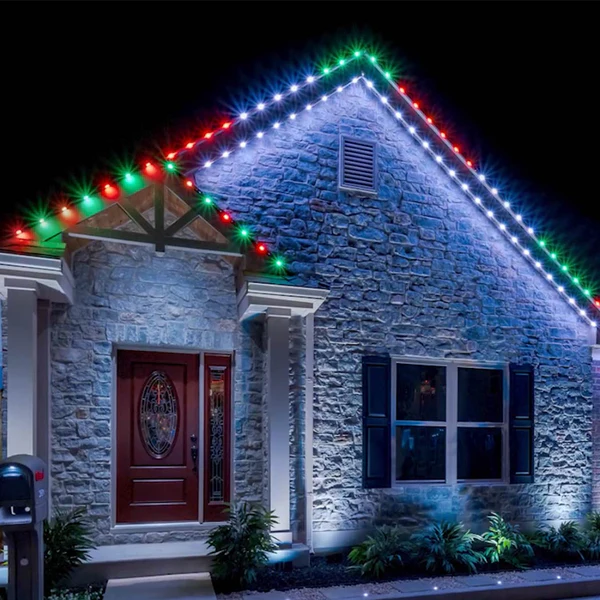
LED Christmas lights beat incandescent in every measurable category: they last 25x longer, use 80-90% less electricity, generate almost no heat (lower fire risk), maintain consistent brightness across the strand, and cost less to operate. Incandescent lights have one advantage: the warm, slightly imperfect glow that some people associate with nostalgia.
The head-to-head comparison
| Category | LED | Incandescent |
|---|---|---|
| Lifespan | 50,000+ hours | 2,000 hours |
| Energy use | 0.07 watts/bulb (C9) | 7 watts/bulb (C9) |
| Heat output | Cool to touch | Hot (fire risk) |
| Durability | Shock-resistant, no filament | Fragile filament |
| Cost per season | $2–$10 electricity | $20–$70 electricity |
| Bulb failure | Strand stays lit | Strand may go dark |
| Color consistency | Maintains color for years | Dims and yellows |
| Environmental impact | Lower | Higher |
Where LED wins decisively
Safety: Incandescent C9 bulbs get hot enough to burn skin, melt plastic, and ignite dried-out roofing material. LED C9 bulbs stay cool to the touch even after hours of operation. The NFPA recommends LED specifically for reduced fire risk.
Longevity: A quality LED C9 lasts 50,000+ hours. At 6 hours per night for 60 nights per season, that's over 130 seasons. An incandescent C9 lasts about 2,000 hours — roughly 5 seasons.
Brightness over distance: LED maintains consistent brightness across the entire strand regardless of length. Incandescent strands lose brightness at the far end due to voltage drop. For roofline lighting, LEDs provide a dramatically more professional result.
See what permanent lighting looks like on your home
Free custom design. One firm price. No pressure.
Where incandescent has a point
Old-school incandescent bulbs have a warm, slightly flickering quality that some people associate with childhood Christmases. The light is softer, slightly amber, and varies slightly from bulb to bulb in a way that feels organic. Modern LED warm white replicates this closely — close enough that most people can't tell the difference from the street. But up close, there IS a difference.
This is the ONLY advantage incandescent has, and it comes with higher cost, higher risk, and higher maintenance. Every professional Christmas light installer uses LED exclusively. See what are C9 LED Christmas lights for more.
Frequently Asked Questions
You can, but the color temperature difference is visible side by side. All-LED is the consistent choice.
Modern LED warm white (2700K) is very close to incandescent. Five years ago, LED warm white looked cold and blue. That's no longer the case.
Nostalgia and the specific quality of incandescent light. Both are valid reasons. But for safety, cost, and performance, LED is objectively better.
Written by Trey, Owner — Heartland Holiday Lights
Trey is a Council Bluffs local and hands-on installer who designs and installs every permanent smart-lighting system Heartland Holiday Lights puts on homes across Western Iowa and the Omaha metro. When he writes about rooflines, channel, and controllers, it's because he's on the roof doing the work.
See what permanent lighting looks like on your home
Free custom design. One firm price. No pressure.